 read
read  see
see 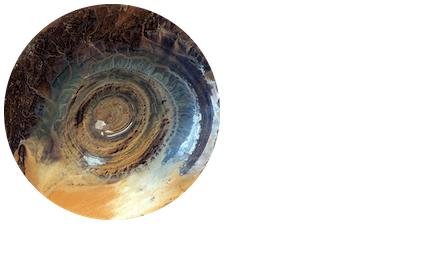
a technical briefing
A word of caution 🔝
Overall, the reader must treat this document as an entertaining informal mental exercise more than anything else.
Exact sciences and engineering disciplines are used more in a metaphorical than in a precise sense.
This research effort has never been properly formalized.
The only decisive, falsifiable prediction proposed is the existence of an artificial subterranean megashelter underneath the Richat Structure — a hypothesis currently exceedingly difficult to test. Difficult — not impossible! We can dig Richat.
Introduction 🔝
The Atlas Hypothesis was a sporadic, multi-decade research effort that treated the mythologies of the world as a redundant but corrupted dataset that had passed through a high-noise information channel. The effort then attempted to reconstruct potentially real events from mythological correlates. The initial goal was to better understand, learn, and improve upon the meta-skill of scientific discovery and engineering through the past experience of humanity — never expecting to find anything beyond the single-directional, sequential, and gradual development of humanity. The assumption was that the mythological corpus is an untapped source containing yet-undiscovered valuable information. Yet with time, unintentionally, the effort included in the set of hypotheses the possibility of a different view of the history of humanity — because the low-effort, low-risk but outsized-profit-potential outcome of finding valuable information, provided one of the non-gradual hypotheses turned out to be correct. The effort was later further encouraged by noticing how many talented individuals throughout history had turned to the same source — circumstantial validation that there was indeed value in doing so. This research effort has now been inactive for years, with no further work planned in the foreseeable future, as it lies outside the author’s primary interests.
The name reflects the fact that, as a result of the effort, many hypotheses merged, and in the limit all mythologies converged on the existence of a single entity that disproportionately defined the history of humanity — Atlas. The word “disproportionately” here is an understatement — practically everything in the history of civilization as we know it today can be traced back, in one way or another, to that entity — a singular bottleneck point in space and time that, functionally and not just metaphorically, became “the seed of civilization.”
This convergence phenomenon has been noted many times by many people, yet, to the best of the author’s knowledge, it has never been taken to its logical conclusion — comprehensively analyzing the entity itself, inferring its characteristics from a grounded engineering viewpoint, matching it to the most plausible known artificial and natural phenomena, and then operationalizing the result as an extended set of constraints and templates in order to recursively infer and analyze other potential mythological correlates preserved in incomplete or corrupted form within humanity’s mythological corpus. This idea should be obvious to those familiar with information theory — or to anyone who has tried to put a broken plate back together — so no further general introduction is needed, and the more specific details do not matter for the purpose of this text.
The name “Atlas” was chosen to signify the merged-hypotheses subspace for the property of being maximally neutral, as well as to acknowledge the moral values and foundational role of the mythical character — in the same way that this single entity now served as a structural backbone for this direction of the effort.
No automation toolset is required for understanding or working with the Atlas Hypothesis. There is also no need for any unconventional information sources; it is sufficient to have a high-school-level education, access to the source material — the mythologies and legends of the world — and familiarity with the contemporary mainstream exact sciences curriculum.
What: a space elevator and a shelter 🔝
Atlas 🔝
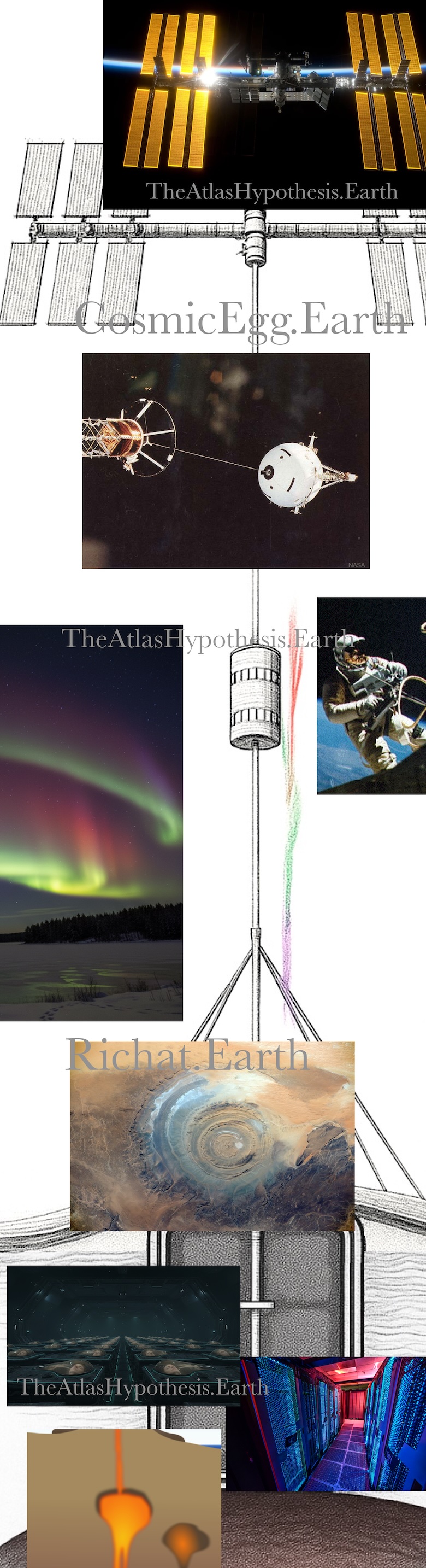
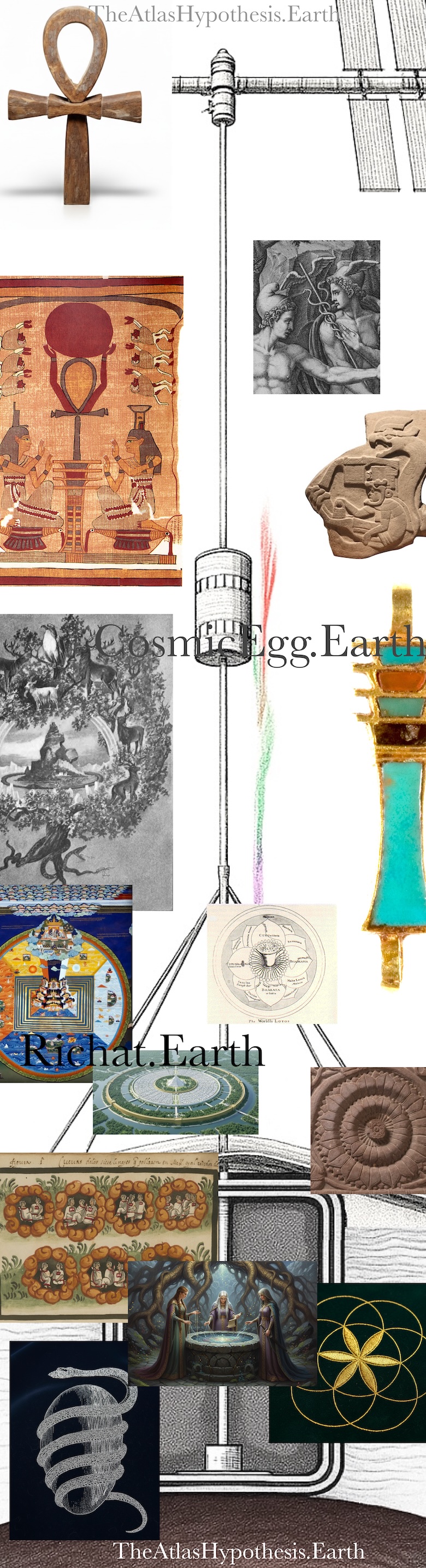
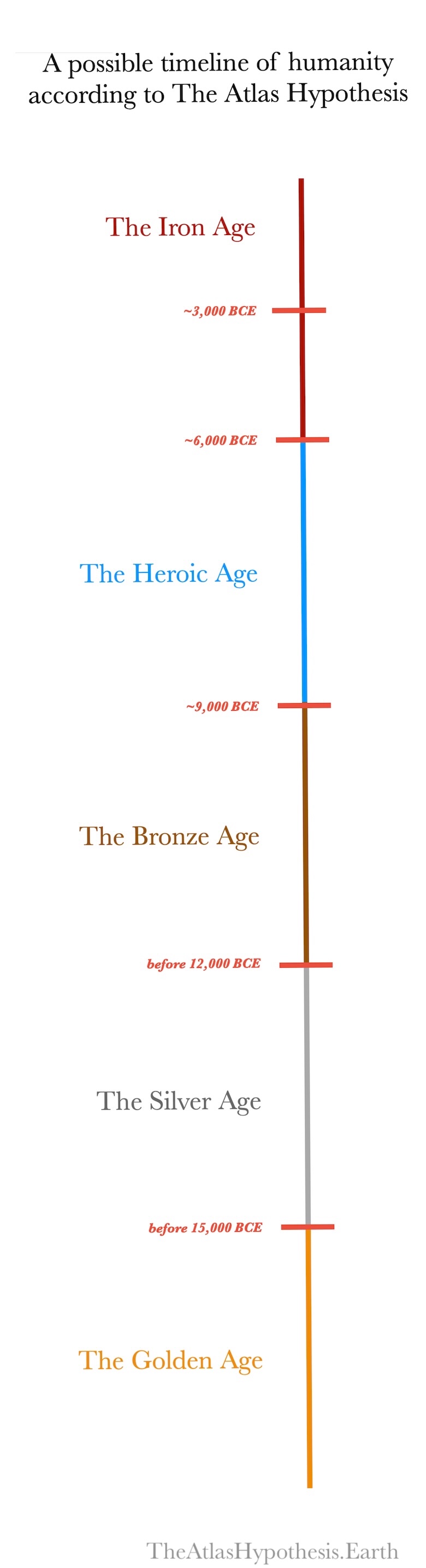
The primary entity of the Atlas Hypothesis is Atlas itself — a space elevator located at the Richat Structure, with some no longer operational components still existing underground at that location. Atlas is hypothesized to have begun operating sometime before ~15,000 BCE, still within the Golden Age of humanity — the existence of which, in turn, is a natural consequence of the hypothesis — and to have ceased operation no later than ~9,000 BCE, with ~12,000 BCE being a strong candidate. Atlas is inferred to have been built as a “civilization re-seeding device” in anticipation of an extinction-level event erasing humanity and its technology elsewhere, and thus contained, in an energetically self-sustaining and operationally autonomous manner, everything required to withstand catastrophic physical loads and subsequently bootstrap the planet’s industrial capacity from scratch.
The Atlas Hypothesis requires a corollary — that the Earth must have undergone some kind of reorientation — either a true polar shift or global lithospheric slippage — with the exact mechanism being irrelevant and left outside the scope of the research effort.
The structure of Atlas
Atlas is hypothesized to consist of four primary structural components, if counting the tether:
• an apocalypse-survival shelter capsule submerged within the crust;
• an exoatmospheric cabin positioned above the stratosphere but below the inner Van Allen belts, within Earth’s magnetospheric protection zone;
• a very large-scale solar array;
• the tether.
Mythological correlates for Atlas
Some names encountered in myths:
• Trailokya
• Yggdrasil
• Mount Meru
• The Djed pillar
The shelter 🔝
The structure of the shelter
For reasons unclear yet seemingly supported by mythological texts, the primary survival mechanism of the structure has been inferred to be a very large ellipsoidal metal shell placed in a cavity within an igneous diapiric dome, emptied of magma — the surface feature of which we know today as the Richat Structure.
The shelter, as described in many legends and consistent with what one would expect geologically, continuously existed under persistent isostatic pressure and thermal strain. The most probable inferred counteraction mechanism is rather surprising — the shelter was surrounded by air streams at all times, which carried away heat and possibly provided air-cushion support.
The size of the capsule is hypothesized to have been what we today would consider gigantic — on the order of the Earth’s crustal thickness. At the upper bound, the whole Richat Structure could represent just the top dome of this subterranean complex.
The end of life for the shelter was probably catastrophic — with the internal voids being flooded by magma, destroying a significant portion of everything and everyone inside at the time. The cause of that catastrophe is not clear — it could have been a direct physical effect on the shelter itself or a loss of energy from a broken tether leading to systemic failure of the protection mechanisms. The shelter structure, now nonfunctional, is assumed still to be located underground beneath the Richat Structure.
The contents of the shelter
The primary purpose of the shelter is hypothesized to have been that of a self-contained civilization-restarting mechanism, constructed in anticipation of an imminent existential threat — potentially a large-scale extinction event. To preserve the knowledge and automation required for a highly developed civilization to function, the capsule probably contained a large-scale component that we would call a “computer cluster” today, serving a very similar function in a very similar manner.
The second major part of the civilization-restarting mechanism was probably the group of individuals belonging to the civilization that built Atlas. It is hypothesized that they were put into a state of suspended animation with full preservation of their biological bodies. This is consistent with most myths and legends of sleeping ancient beings awaiting the end of the world, then awakening physically to restart the civilizational order of humanity.
A less plausible idea involves some kind of preservation of their disembodied minds — regardless of the specific mechanism or degree — whether through training the compute cluster mentioned above from the brain’s connectome or directly preserving their brains in vats — a possibility hinted at by the story of Odin and Mímir.
Besides these two primary components, it is clear from the myths that the shelter also served a secondary function: during destruction events between cycles, it preserved samples of less-developed human populations from around the world. Those individuals and groups were taken into the shelter and later released back into the open environment. After release, they were clearly guided and aided in creating and developing primitive agricultural societies on the post-apocalyptic planet — whether voluntarily or not is unclear.
Mythological correlates for the shelter
The shelter has been known under many names. It has also often been subdivided into two primary parts — the subterranean volume and the ground surface around its upper tip.
The submerged part and its subdivisions have been known under names such as:
• the Cosmic Egg
• Amenti
• Duat
• Chicomoztoc
• Pātāla
• the Well of Urd
• the Caves of Boreas
• the Primordial Mound
The surface around the top of the submerged capsule has been a prominent component of many myths by itself — both before and after the collapse event — known under names such as:
• Alatyr
• the Seven Continents Around the Cosmic Mountain
• Heliopolis
• Babylon (note that this differs from the later Mesopotamian city)
• Atlantis
• the Navel of the World
The exoatmospheric cabin 🔝
Above the atmosphere but below the inner Van Allen belts, the tether was equipped with a habitation module.
It is unclear why this component would have been deemed necessary by the designers of Atlas. The cabin is understood, based on legends, to have existed in an environment unsuitable for unprotected human survival and to have consisted of enclosed rooms.
A particularly valuable insight is the repeated mythological reference to “caves of immortals” that mention direct observability of the auroral effect from within — confirming that the cabin was located within reach of the upper portion of the aurora, at the very edge of Earth’s atmosphere.
The size of the cabin is described in many myths as being much smaller than the underground shelter. Its environment is likewise described as austere or even Spartan compared to the lavish conditions of the shelter — exactly what one would expect from the structural constraints of such a construct.
At the top of the structure, an observation deck and C&C room were located — mentioned, for example, as Zeus’s observation point.
The solar array 🔝
In the setting of a destroyed civilization and the dire need for massive amounts of energy to restore it, the solar array clearly played a critical role. Intriguingly, some myths mention periods of partial insolation and the solar array functioning as a reflective or luminous structure — possibly a mechanism to mitigate damage from impact winters.
Besides the tether connecting the power component to the shelter, it is very possible that some kind of wireless transmission was employed, as many mythologies mention receiving energy from a specific direction, and Egyptian art clearly depicts rays emanating from the Ankh — the Egyptian symbol for this component.
The tether 🔝
The structure of the tether
The tether was connected to the underground shelter and provided at least part of the energy required for survival.
It is obvious from both modern engineering knowledge and the myths that the tether must have been made of some very advanced material. Unfortunately, that is as much information as the myths provide.
The tether is described in Hindu mythology as being rooted in a “turtle-back” construct — which can safely be assumed to represent the Richat Structure dome. From Chinese myths, we learn of fifteen “turtle feet,” though it is unclear whether these were attachments on the same “turtle back” or other locations on the planet that docked space-elevator tethers.
We can impose upper bounds on the rigidity and structural integrity of the combined tether and “turtle back/feet” if we recall that the tether is said to have been “broken” during the “tilting of the sky” event and “snapped” during the same or another damaging occasion. This kind of damage presupposes that the tether was docked at the time.
Another hint that the tether remained dangerously docked during cataclysms is the breaking of the Rainbow Bridge — though that could have been coincidental if an incoming asteroid bombardment managed to strike the tether directly. According to ancient Trailokya legends, all three components of the megastructure were destroyed during the same event, so all three may indeed have been hit. Assuming only the tether was damaged, the resulting loss of power would have led to failure of the shelter, creating the illusion that both were destroyed (the state of the solar array being unobservable from the ground).
During the same “tilting of the sky” event, we learn that, in order to repair the tether, four additional tethers were added — and from other Eastern mythologies, we can infer that these were guy wires, as they were explicitly described as “filaments of a lotus.”
Finally, the material of the tether could not sustain high temperatures — Mount Meru is said to have “melted, leaving no ashes.”
Mythological Correlates for the Tether
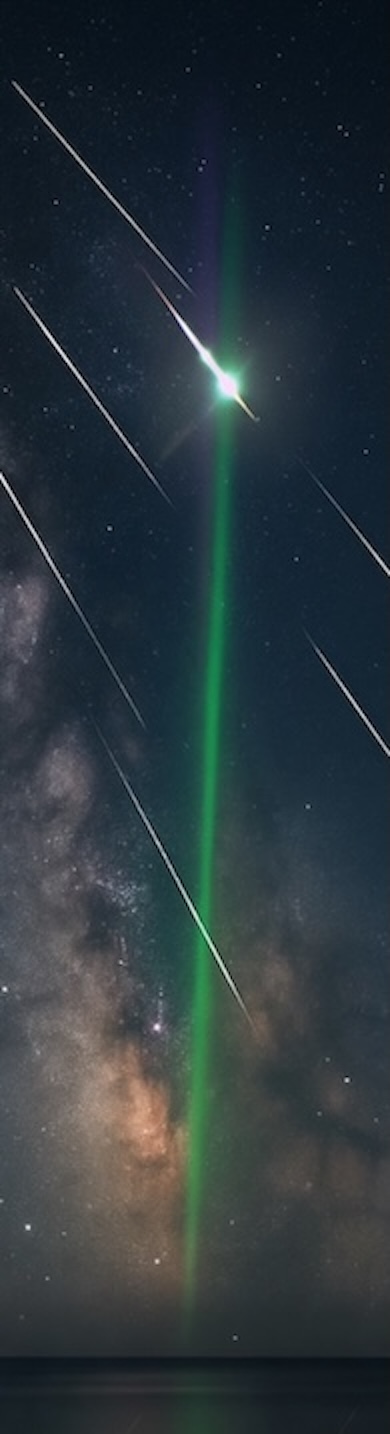
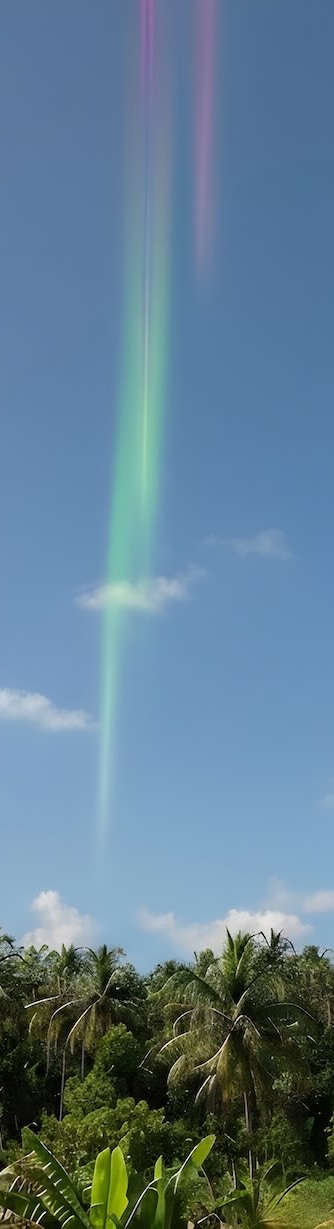
It was most probably the ionization and plasma-glow effects caused by the tether interacting with the upper atmosphere that made the atmospheric portion of the tether so visually striking. This segment has been known in myth under names such as:
• Iris, the Rainbow Messenger
• the Rainbow Bridge
• the Rainbow Serpent
• the Flower Road
Note, however, that such a “rainbow” would differ greatly in appearance from the rainbow caused by sunlight passing through raindrops — its visible spectrum would be dominated by the emission bands of oxygen and nitrogen: green, red, and purple. The Norse myths, either accidentally (as they inhabited regions where auroras are common) or through true historical memory, describe this three-colored type of rainbow.
The breaking event during the axial shift introduced four additional components as reinforcement for the damaged structure, known under names such as:
• the Sons of Horus
• the Four Dwarfs
• the four mountains around Mount Meru
The tether is sometimes described as a functional component as well — a rope leading to the sky, used by the protagonists of various legends to visit celestial beings.
Where: Earth, Richat structure; prehistoric equator 🔝
The shelter is hypothesized to have been placed within a very specific igneous diapir dome — the geological formation we know today as the Richat Structure, completely submerged as of today.
An inferential consequence is that the builders of Atlas must have been capable of operating on a much larger planetary scale than at our current technological level — otherwise, the hypothesis would require a nearly impossible coincidence: the formation of a unique geological structure almost exactly on the planet’s former equator.
Other observables that are difficult to explain without invoking planetary-scale engineering become trivially explicable under such an assumption.
Regarding the crustal shift, there is strong indication that such a shift occurred without fracturing — either via planetary reorientation or slippage of the entire crust while deeper layers preserved their original configuration. The motivation for involving a non-breaking shift is that otherwise one must assume a number of nearly impossible coincidences to explain the global “navel of the world” chain of sites — all located on the same great circle and historically describing themselves as tether docking points for a space elevator connecting heaven and Earth via a rope-like structure.
A crustal shift occurring without rupture would trivially explain these sites’ current positions if that great circle once corresponded to the planet’s equator and later shifted as a solid body.
As evident from the above, there are strong indicators pointing to the existence of other space-elevator docking locations — the most promising secondary site being Easter Island. Every historical site that called itself the “navel of the world” and lay on the same great circle is suspected to have been a docking station capable of accepting a space-elevator tether.
Whether more than one space elevator existed is far less certain. There are reasons to believe that at least a few very large space habitats existed in orbit around the planet and that some of those habitats were later converted into space elevators.
As for other indications that the Richat Structure was the location of Atlas, one can recall that the Egyptians claimed Amenti to be located to the west of Egypt, while Herodotus directly mentions the existence of a supertall megastructure he calls a “round and infinitely tall mountain” in roughly the same place where the Richat Structure is located.
Who: Humans 🔝
Globally 🔝
To understand the Atlas Hypothesis, the conservatively traditional mainstream conceptual framework is entirely sufficient. Earth-native biology and technology explain every observable — there is no need to invoke any agency external to Earth.
However, the system is not assumed to be closed in general — for example, extraterrestrial intelligence and simulation hypotheses are compatible with the Atlas Hypothesis, though they are assumed to have had no influence within the model, which remains fully explainable parsimoniously without them.
It is important to note that the Atlas Hypothesis does not concern deeper existential questions, and the author personally believes in the reality of the immortal soul, good and evil, and higher judgment.
The word “humans” is used here in an inclusive sense — encompassing Neanderthals, Denisovans, and a large number of yet-unknown stable genetic clusters, as well as genetically designed variations. Where the line between human and non-human lies is neither known to the author nor relevant to the Atlas Hypothesis.
Locally (temporally) 🔝
Atlas is assumed to have been created by the humanity of the Golden Age — a civilization that, no later than 15,000 BCE, reached technological stages still beyond our current capabilities (and it remains an open question whether it is even possible for us to reach that level ourselves).
Locally (spatially) 🔝
The existence of Atlas as a self-sustaining, hardened survival shelter accompanied by a space elevator structure is the crux of this hypothesis. The hypothesis does not require, in its most limited sense, anything beyond that. This limits the location to the Richat Structure.
However, the mythologies of the world hint at more than one space elevator in existence, as well as untethered space habitations, some of them potentially housing very significant permanent populations.
Noticing the chain of supposed “tether ports” also hints at either the ability of space elevators to migrate between them or the existence of several permanent ones.
Why: the Encke Comet, Taurids 🔝
The hypothesis of the Taurid complex being the reason behind the repeated destruction of humanity fits all the requirements for the Atlas Hypothesis. No other source of destruction is needed. This is well known today and championed by hardworking, highly talented individuals, so the author advises readers to learn from them directly.
The only caveat is that, at the time when Atlas was constructed, the configuration was quite possibly different in some way — but any such difference would make the Taurids more, not less, dangerous, because no accretion can occur while fragmentation increases with time. Hence, in earlier epochs, the stream would have contained larger fragments before disintegration, making encounters more devastating. It is even possible that the creation of Atlas was accompanied or preceded by technological attempts at breaking up either the progenitor comet or its larger fragments.
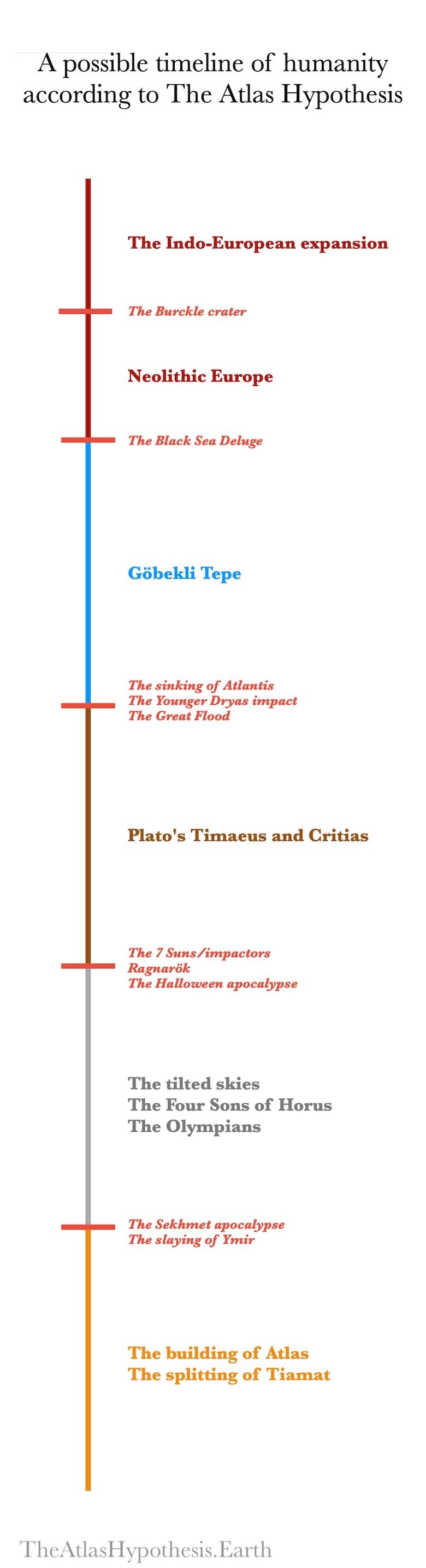
The order of events 🔝
Before 15,000 BCE
The Golden Age civilization develops and reaches its zenith.
A giant comet enters the solar system, and its fragments are captured in a resonant orbit that crosses the Earth's orbit. It is recognized as a threat.
Atlas is either built from scratch or recycled from a previously existing space elevator.
Before 12,000 BCE
The first cycle destroys the Golden Age civilization and a significant part of the planet's population. The space-based habitats remain functional.
Atlas endures the first cycle and attempts to restore civilization.
After one of the cycles, some kind of rebellion, or several, takes place, and the original population of the hibernation pods is denied access to the surface. The myths of bodhisattvas and the Zeus rebellion hint at at least one such episode.
It is in this time interval that what we now know as the Silver Age or the Second Sun takes place.
At some point, the Earth is reoriented, and the equator shifts, leading to the tether of Atlas breaking. It is repaired with the help of four supporting substructures, possibly taken from other megastructures that existed at the time. This event is known as a prototypical goddess, sometimes aided by a prototypical demigod, restoring order. In Egypt it is Isis, in Mesopotamia — Inanna, in China — Nüwa.
Before 9,000 BCE
During one of the cycles, Atlas is destroyed. We do not know from myths the exact nature of the destruction, yet at least the myth of Trailokya states directly that the destruction was complete — all three components failed. This is the event we also know as Ragnarök.
After Atlas is destroyed, on its ruins, on top of the shelter, Atlantis is founded.
It is possible that the shelter still retained some function, because there are traditions claiming continuous existence of Amenti, descriptions of which match the function of the shelter's knowledge-preservation mechanism.
~9,000 BCE
The date of the destruction of Atlantis provided in the myth conveyed by Plato matches almost exactly the Younger Dryas impact hypothesis event.
The corresponding myths of the Mesoamerican tradition indicate that quite possibly the rulers of Atlantis, who claimed to have descended from the population of Atlas, attempted to restore their empire, with the new capital at Teotihuacan.
~500 BCE
Abaris is said to have visited Greece and lived with Pythagoras while operating an aircraft. This indicates the possibility of a technological legacy of Atlas still percolating through the world. In one of the accounts, it is also claimed that Pythagoras showed Abaris some kind of proof of also belonging to the same population and was able to operate the aircraft.
Conclusion 🔝
The author believes that, for a person prepared to invest in investigating the topic, there is currently an opportunity to make significant and rapid progress in several essentially untouched directions of cultural — but also potentially historical and engineering — interest. The author himself is not such a person.
From his personal point of view, however, and provided such prior civilizations existed, the author cautiously hopes to see some records from those previous cycles of civilization discovered and/or made public — if only to satisfy his curiosity.
— Al Kha ⵣ the author of The Atlas Hypothesis